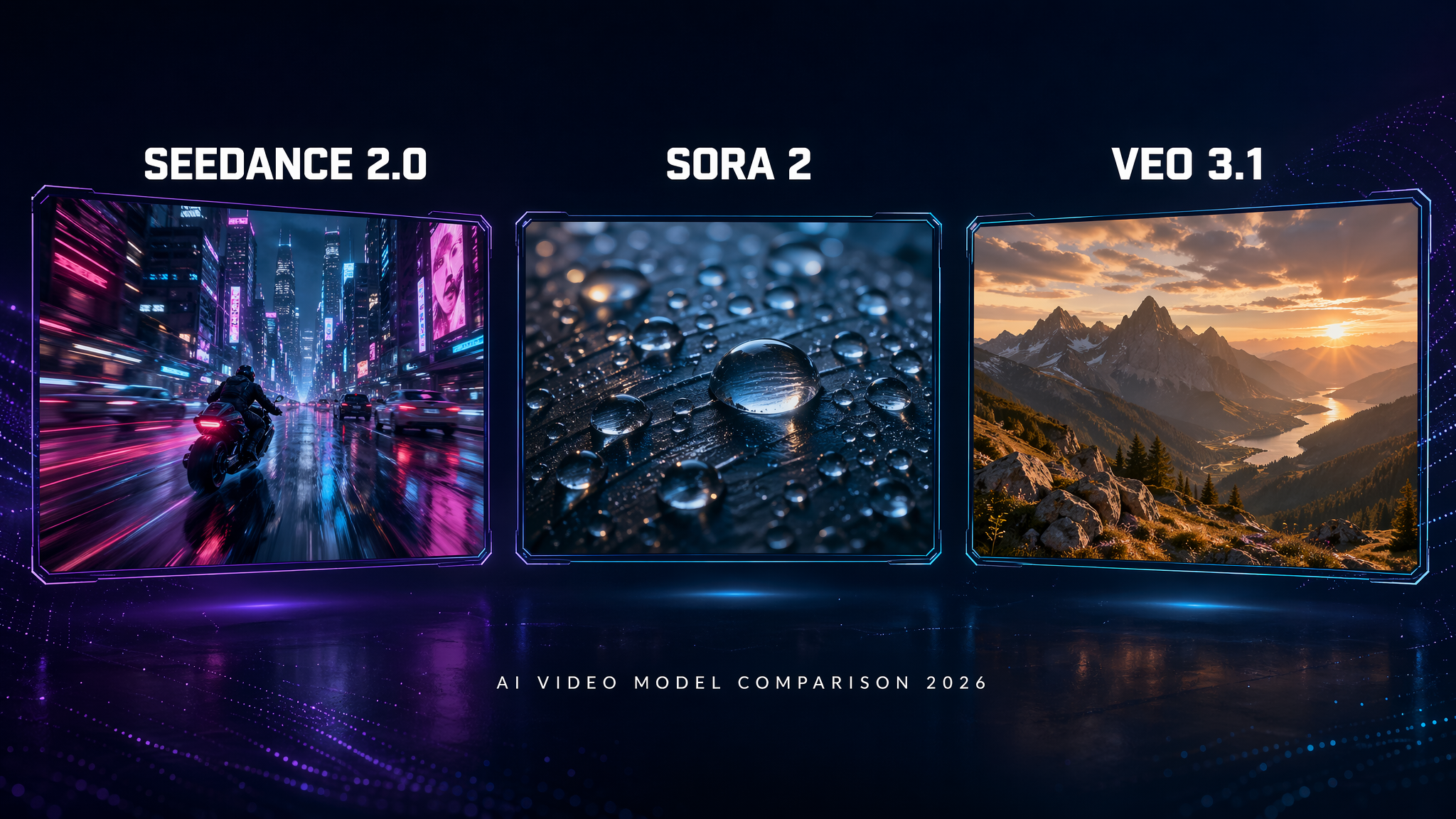
Seedance 2.0 vs Sora 2 vs Veo 3.1: Which to Use When (2026)
By the GenMix Editorial Team — last updated April 2026. We tested all three models with 50+ prompts across cinematic, social media, product demo, and animation scenarios over a 3-week evaluation period.
Quick answer: Seedance 2.0 is the best overall AI video generator in 2026 for most creators — it offers multi-modal input (text, images, video, audio references), the lowest cost per second, and a #1 ranking on the Artificial Analysis Video Arena. Choose Sora 2 for physics-heavy or long single-shot scenes (up to 25 seconds). Choose Veo 3.1 when you need true 4K cinematic output. The right pick depends on your specific project, not on which model is "best."
If you have spent any time in AI video circles in 2026, you have heard the same three names over and over: ByteDance's Seedance 2.0, OpenAI's Sora 2, and Google DeepMind's Veo 3.1. Each one is being called the best AI video model by someone, somewhere, every week.
That gets confusing fast. They are not really competing for the same crown — they are good at different things, and the right pick depends entirely on what you are actually trying to make.
This guide skips the "which model wins" debate. Instead, it gives you a clear decision framework: what each model is genuinely best at, where each one falls short, and how to pick the right tool for the job in under five minutes.
You can try all three side by side on GenMix, so the comparisons below are based on hands-on use, not just spec sheets.
This guide covers: head-to-head specs comparison, real-world same-prompt test results, pricing breakdown, a 4-step decision framework, and FAQs about commercial use, audio support, and prompt engineering.
The 30-Second Verdict
If you only have 30 seconds, here is the short version:
The short version: Seedance 2.0 wins on versatility and value, Sora 2 wins on physics and storytelling, Veo 3.1 wins on cinematic 4K quality. Most projects benefit from picking based on use case rather than committing to one AI video model exclusively.
Your goal
Pick
Cinematic 4K commercial or trailer
Veo 3.1
Realistic physics, long single-shot scene
Sora 2
Multi-reference creative control, social-ready
Seedance 2.0
Image-to-video animation with style consistency
Seedance 2.0
Storyboarded multi-scene narrative
Sora 2
Best value across most use cases
Seedance 2.0
Key takeaways:
✅ Seedance 2.0 ranks #1 on the Artificial Analysis Video Arena and offers the best cost-per-second value with a 90% first-try success rate
✅ Sora 2 holds the longest single-clip duration (25 seconds) and the most realistic physics simulation in any current AI movie generator
✅ Veo 3.1 is the only model that outputs true 4K (3840×2160) at the cinema-standard 24fps
✅ No single winner — choose based on output destination, creative control needs, duration, and budget
✅ GenMix lets you compare all three video generation models on one platform without subscribing to three separate AI video software services
That table covers maybe 80% of decisions. The rest of this article explains why — and helps you handle the trickier 20%.
Meet the Three Contenders
Seedance 2.0 — The Multi-Modal Specialist
Seedance 2.0 is ByteDance's flagship AI video model and AI movie generator, launched in February 2026. It currently sits at #1 on the Artificial Analysis Video Arena leaderboard for both text-to-video and image-to-video, ahead of every competitor we are about to discuss.
The headline feature is its quad-modal input: in a single generation, you can feed it a text prompt, up to nine reference images, three reference video clips, and three audio references. No other model in this comparison comes close to that level of creative guidance.
Output is 2K at 24 or 30 fps, up to 15 seconds per clip. Reported first-try success rate of 90% — meaning fewer wasted credits on regenerations.
Sora 2 from OpenAI is the model people think of first when they hear "AI video," and for good reason. Its physics simulation is still the best in the industry — objects respond to gravity, momentum, and collisions with a believability the others have not matched.
Sora 2 also holds the longest single-clip duration at 25 seconds, and its Storyboard tool lets you plan multi-shot scenes that flow naturally without visible cuts. The Cameo feature handles character consistency across multiple shots, which is harder than it sounds.
Where Sora 2 falls short: only one reference image per generation, no native audio in most modes, and resolution caps below Veo 3.1.
Sora 2 on GenMix gives you the same model accessible through OpenAI's official API, plus alternative providers if you need the Pro variant. OpenAI's official Sora 2 system card covers safety policies and capability details.
Veo 3.1 — The Cinematic Specialist
Veo 3.1 from Google DeepMind is the only model in this comparison that outputs true 4K (3840×2160) at 24 fps — the cinema standard. If you are producing content that will end up on a big screen or in a polished commercial, Veo's color science and motion blur are noticeably more "broadcast-ready" than the alternatives.
The "Ingredients to Video" feature lets you combine multiple reference materials (similar to Seedance's multi-modal input, but more limited), and scene extension means you can stretch shorter clips into longer narratives.
Where Veo 3.1 lags: shorter clip duration than Sora 2, fewer reference inputs than Seedance 2.0, and the highest credit cost per second of the three.
You can run Veo 3.1 on GenMix without needing a separate Google Cloud account. Google's DeepMind Veo 3.1 page outlines the model's architecture and supported features.
Side-by-Side Specs Comparison
These three text-to-video AI models trade off in different dimensions. Here is the full spec sheet for the most current video generation models we tested:
Feature
Seedance 2.0
Sora 2
Veo 3.1
Max resolution
2K
1080p (Pro: higher)
4K
Max single-clip duration
15s
25s (Storyboard)
8-12s
Frame rate
24/30 fps
24 fps
24 fps (cinema)
Native audio
✅ Synced
⚠️ Limited modes
✅
Reference images
Up to 9
1
Multiple (Ingredients)
Reference videos
Up to 3
None
None
Reference audio
Up to 3
None
None
Image-to-video
✅
✅
✅
Reference-to-video (R2V)
✅ Unique
❌
❌
Multi-shot storyboard
❌
✅
⚠️ Scene extension
First-try success rate
~90% reported
~70% est.
~75% est.
The bolded cells show where each model is the clear leader in that category. There is no row where one model wins everything — the tradeoffs are real.
Real-World Test: Same Prompt, Three Models
Methodology: Each generative video AI model was tested with the same prompt at a comparable quality tier (Seedance 2.0 at 1080p, Sora 2 Pro, Veo 3.1 at 1080p). Results were generated within a 24-hour window to ensure model versions were comparable. We avoided cherry-picking — the videos below are the first-try output for each model.
We ran the same prompt through all three models on GenMix:
"A young woman in a yellow raincoat walks through a Tokyo alley at night, neon reflections in puddles, slow tracking shot from behind, cinematic, 4K, moody atmosphere"
Watch each model's output side by side:
Seedance 2.0 — 1080p, generated in ~30 seconds
Sora 2 Pro — highest quality tier, generated in ~60 seconds
Veo 3.1 — 1080p, generated in ~45 seconds
What we observed:
Veo 3.1 produced the most "film-like" output — the neon color reflections were stunning, the rain physics were believable, and the camera movement felt smooth and intentional. Best frame for frame in terms of broadcast-ready color science.
Sora 2 Pro delivered the most physically realistic version — the way the raincoat moved with each step, the pooling water, the subtle parallax of background buildings — all felt grounded. The Pro tier's motion quality was outstanding and justified the higher credit cost.
Seedance 2.0 was the fastest to generate and gave us the most flexibility. We then re-ran it with a single reference image of a specific Tokyo street, and the result inherited the lighting style of that reference perfectly. None of the other models could do that in one pass.
Verdict per category:
Visual polish: Veo 3.1 wins
Physical realism: Sora 2 wins
Style control & speed: Seedance 2.0 wins
If you are choosing on output quality alone, the choice depends on which axis matters most for your project.
Pricing & Cost Analysis
Cost is where comparison articles usually wave their hands. Here are real numbers based on GenMix's credit-based system, which gives you all three models on one bill.
Model
Credits per second (1080p+ tier)
Relative cost
Seedance 2.0
~15-50 (varies by resolution)
Lowest
Sora 2
~25-50
Medium
Veo 3.1
~10-50
Medium-low
Veo 3.1 Pro
~50-180
Highest
For a typical 10-second social media clip:
Seedance 2.0 at 1080p: roughly 350 credits
Sora 2 at standard quality: roughly 250-500 credits
Veo 3.1 at 4K: roughly 150-200 credits, but Pro tier escalates fast
Practical takeaway: Seedance 2.0 gives you the best cost-to-creative-control ratio. Veo 3.1 is surprisingly affordable for non-Pro tier 4K. Sora 2 sits in the middle. Veo 3.1 Pro is reserved for projects where 4K cinematic output is non-negotiable.
GenMix runs a credit-based system where one subscription gives you access to all three models, so you are not committed to any single ecosystem.
Decision Framework: Which One Should You Pick?
Here is the decision tree we use internally when picking a model for a new project:
Start with output destination
Cinema, broadcast, large-screen: Default to Veo 3.1 for its 4K cinema-grade output
TikTok, Reels, YouTube Shorts, Instagram: Default to Seedance 2.0 as a short video generator AI for vertical-friendly resolution and speed
Web embed, presentation deck, internal review: Either Veo 3.1 (non-Pro) or Seedance 2.0 — flip a coin, both are fine
Then check creative control needs
You have specific reference materials (images, brand assets, style guide): Seedance 2.0 wins by a mile — quad-modal input is genuinely unmatched
You need character consistency across multiple shots: Sora 2 with Cameo + Storyboard
You need physics realism (water, cloth, collisions, gravity): Sora 2
Then check duration
Single shot under 8 seconds: Any of the three
Single shot 8-15 seconds: Seedance 2.0
Multi-shot narrative 20-60 seconds total: Sora 2 with Storyboard
Single shot needs to be 25 seconds: Only Sora 2 can do this
Finally check budget sensitivity
Tight budget, high volume: Seedance 2.0 — best success rate means fewer regenerations
Premium one-shot project: Veo 3.1 Pro for 4K cinematic
Mid-budget, balanced: Sora 2 standard or Seedance 2.0
How to Try All Three Without Subscribing to Three Services
The traditional way to compare these AI video software platforms means signing up for OpenAI's Sora platform, Google's Veo access, and ByteDance's Dreamina or CapCut Pro — three separate accounts, three separate billing relationships, three different UIs to learn.
GenMix consolidates all three into a single workspace with one credit-based subscription. As an AI video creator, you select the model from a dropdown, run the same prompt on each, and compare results in the same dashboard. No need to context-switch between apps or re-authenticate.
This is particularly useful for teams that need to A/B test which model fits a specific brand voice or visual style. Run your three favorite prompts through each model, compare side by side, and pick the winner — all in one session.
GenMix also includes a library of creative effect templates that work across multiple base models, so you can experiment with one-click stylistic transformations rather than always writing prompts from scratch.
When NOT to Use Each Model
To balance the rest of this guide, here is when not to pick each model:
Skip Seedance 2.0 if: you need a single shot longer than 15 seconds, or you require true 4K output for broadcast distribution
Skip Sora 2 if: you have many reference materials to work with, or you need synchronized audio in standard tier
Skip Veo 3.1 if: budget is tight, or you need flexible reference image inputs (more than 2-3)
These are not deal-breakers — every AI video model has weak spots. Knowing them upfront saves credits and frustration.
FAQ
Is Seedance 2.0 actually better than Sora 2?
Yes, on most benchmarks. Seedance 2.0 ranks #1 on the Artificial Analysis Video Arena Elo leaderboard for both T2V and I2V categories, ahead of Sora 2.
But "better" depends on what you measure. For physics realism and longest single-shot duration, Sora 2 still wins. For multi-modal creative control and first-try success rate, Seedance 2.0 wins.
Can Veo 3.1 generate audio?
Yes. Veo 3.1 supports synchronized audio generation natively in most output modes.
Seedance 2.0 also supports synced audio. Sora 2's audio support is more limited and varies by tier — the standard tier outputs silent video in most modes.
What is the difference between Seedance 2.0 T2V, I2V, and R2V?
T2V generates from text, I2V animates an image, R2V uses multiple reference materials in a single pass. R2V is Seedance 2.0's signature mode.
T2V (text-to-video) generates from text alone. I2V (image-to-video) animates a static image based on text guidance. R2V (reference-to-video) accepts up to nine reference images plus video and audio references in a single generation, giving you the most precise creative control of any model in this comparison.
Which model is the best value for money?
Seedance 2.0. It offers the lowest cost per second at typical resolutions plus the highest reported first-try success rate (~90%).
Fewer regenerations means less wasted credits. For pure dollar-per-finished-clip economics, Seedance 2.0 leads across most use cases.
Can I use these models for commercial projects?
Yes, all three support commercial use, but specifics vary by platform. On GenMix, paid plans include commercial usage rights for content you generate.
Sora 2 has the strictest content policies. Veo 3.1 has clear commercial licensing through Google. Seedance 2.0 commercial terms depend on the access provider — GenMix simplifies this by bundling commercial rights with paid plans.
Do I need different prompts for each model?
The fundamentals work across all three, but each model has prompt strengths. Veo 3.1 rewards explicit cinematography terms, Sora 2 responds to physics descriptions, Seedance 2.0 thrives with reference materials.
The basics (clear scene description, camera movement, lighting cues) work across all three. Veo 3.1 rewards explicit cinematography terms ("dolly in," "rack focus"). Sora 2 responds well to physics-aware descriptions ("wet asphalt reflections," "hair caught in wind"). Seedance 2.0 thrives when you provide reference materials rather than relying on text alone.
Which model handles human faces best?
Sora 2 wins on multi-shot consistency, Veo 3.1 wins on single-shot photorealism, Seedance 2.0 wins when you have a reference photo to maintain.
Sora 2's Cameo feature ensures character consistency across multiple shots. Veo 3.1 produces the most photorealistic single-shot faces. Seedance 2.0's reference image input gives you the most direct control if you have an existing face you want to maintain.
Bottom Line
There is no single winner. Seedance 2.0 is the most versatile and the best value, and it is where most of your generations should probably default. Sora 2 is unbeatable for physics-heavy, narrative-driven work that needs longer single shots or multi-shot consistency. Veo 3.1 is the choice when broadcast-quality 4K is non-negotiable.
The smartest workflow is not to commit to one model — it is to keep all three in your toolkit and pick the right one per project.
Try All Three Free on GenMix
GenMix is built for exactly this: one workspace, one subscription, three flagship video models plus a dozen more, all accessible through the same dashboard. New users get free credits to test all three models on your own prompts before deciding.
Get started in three steps:
Sign up free at genmix.ai — no credit card required
Run the same prompt through Seedance 2.0, Sora 2, and Veo 3.1
Pick your favorite based on real results, not spec sheets
The "right" model becomes obvious within 5 minutes once you see the same idea rendered three different ways.
This article was last updated in April 2026. AI video models evolve rapidly — bookmark this page or check back monthly for refreshed comparisons.